The majority of regions in New Zealand belong to the temperate zone with a maritime climate according to the Koppen classification. Maritime (oceanic) climates are defined as having a mean monthly temperature below 22 °C in the warmest month and above 0 °C in the coldest month. This means that the summers are cool and the winters are cooler.

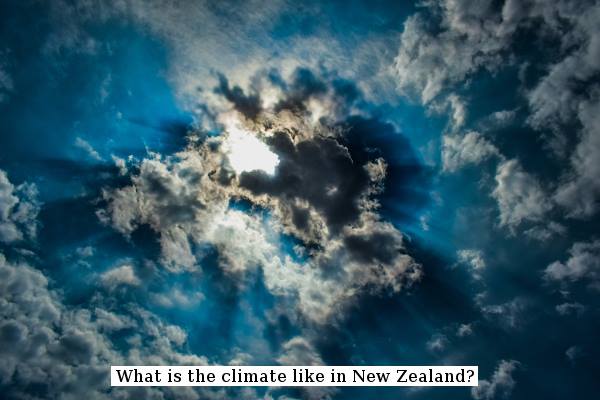
In New Zealand the climate is heavily influenced by the surrounding ocean. The ocean plays a pivotal role in regulating inland temperatures. There are four distinct seasons in New Zealand namely spring (September, October and November), summer (December, January and February), autumn (March, April and May), winter (June, July and August).

Although not as varied as in India, the climate across New Zealand varies quite a lot due to the country’s diverse landscape. New Zealand is home to 3 notable mountain ranges, the Southern Alps, Mountain ranges of Otago and Tararua Range. The impact of these ranges on the climate is significant.

Picture of a beautiful rainbow over the city of Auckland
Rainfall: New Zealand experiences plenty of evenly distributed rainfall throughout the year. Most cities receive between 620 mm-24 mm of rainfall each year. However the amount of rainfall a region in New Zealand receives is influenced greatly by the surrounding topography of that region. In general, New Zealand receives adequate rainfall and does not experience widespread water shortages.

Picture of snow covered berries in New Zealand
Snowfall: Snow falls in New Zealand’s South Island and in higher altitudes in the North Island. Snowfall at sea level in the North Island is very rare, and both islands experience more snowfall inland due to the temperature regulating nature of the ocean.

One can describe New Zealand’s climate as a mild comfortable climate. Living in New Zealand you will be hard pressed to find areas with extreme temperatures. After all the mean annual temperatures range from 10 °C in the south to 16 °C in the north. With that said, students from hot humid tropical climate zones of India are advised to carry some warm clothing with them when going to study in New Zealand because the climate there does tend to lean towards the cooler side.

Read More

When planning to study in New Zealand, you should always check if your particular study programme will result in you obtaining a qualification on the New Zealand Qualification Framework (NZQF). The New Zealand Qualification Framework is a system set by the New Zealand Qualifications Authority (NZQA) which is a government organisation that sets standards for secondary and tertiary education in New Zealand.

If the course you plan to pursue leads to a qualification which is recognized under the NZQF then it means that your qualification is recognized by the Government of New Zealand. Qualifications of this kind are internationally recognized because of their high standards.

The NZQF is divided into 10 levels and they cover a range of qualifications from certificates to doctoral degrees. Given below is a table which attempts to give you an overview of the different levels of qualifications in New Zealand.

LevelCertificateDiplomaDegree
Level 1Certificate--
Level 2Certificate--
Level 3Certificate--
Level 4Certificate--
Level 5CertificateDiploma-
Level 6CertificateDiploma-
Level 7Graduate CertificateDiploma, Graduate DiplomaBachelor's Degree
Level 8Postgraduate CertificatePostgraduate DiplomaBachelor Honours Degree
Level 9--Master's Degree
Level 10--Doctoral Degree
Read More

New Zealand has a three tier education system, the three tiers are :

  • Primary and intermediate schools
  • Secondary schools (High schools)
  • Tertiary education (Universities and polytechnic Institutes)

The scope of this article will be restricted to tertiary education as that is the part which is most confusing for Indian students planning to study abroad. Tertiary institutes in New Zealand are relatively relaxed in admissions of foreign students in the tertiary level due to high demand for educated graduates needed by the rapidly growing service sector.

Tertiary education in New Zealand is used to describe all aspects of post-school education and training. This ranges from informal non-assessed community courses in schools through to undergraduate degrees and advanced, research-based postgraduate degrees. Tertiary education is regulated within the New Zealand Qualifications Framework, a unified system of national qualifications in schools, vocational education and training.

New Zealand is known for its high quality and industry oriented tertiary education system which prepares students for the real world challenges they may face while working. In essence they are ready to face the global job and enterprise market once they graduate.

The 2 main different types of government owned tertiary education providers in New Zealand are:

  • Institutes of Technology and Polytechnics
  • Universities

Institutes of Technology and Polytechnics (ITP)

Institutes of Technology and Polytechnics (ITP) offer general and vocational education. Their curriculum is based on industry oriented learning and practical knowledge in a working environment. In addition to a good amount of theoretical studies the courses offered by ITP’s usually involve completing real life projects in workplaces. This is a very effective form of education as students gain first hand experience about workplace challenges whether it is in the corporate world or in a full-blown industry.

Universities

Universities in New Zealand are characterised by a wide diversity of teaching and research, especially at a higher level, that maintains, advances, disseminates, and assists the application of knowledge and develops intellectual independence.

Quality Assurance System for Tertiary Education Providers in New Zealand

The New Zealand Qualifications Authority has developed and operates an integrated quality assurance system which uses the Evaluative Quality Assurance Framework (EQAF) which:

  • covers the quality assurance of the non-university tertiary education sector
  • uses evaluation theory and practice to reach well-informed, consistent and reliable evidence-based judgements about all aspects of organisational performance and capability
  • has a practical focus on outcomes and key contributing processes
  • builds awareness and improvement through organisational self-assessment.

In short, New Zealand’s education system is very promising, robust and has been proven itself to be effective in churning out world class graduates from almost every single field.

Read More

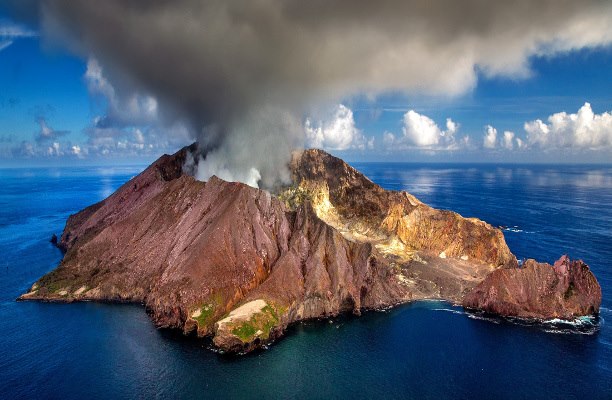
As a child I have always been awestruck by the beauty and power of volcanoes. To me volcanoes invoke a primal awe and fear, their danger does not diminish their raw beauty in any way. These roaring lava belching giants form an integral part of our earths landscape and ecosystem, moulding and shaping it, covering old dead lands with vast new stretches of fertile soil.

Awe inspiring picture of a volcanic caldera in New Zealand
As a person born and raised in the Indian subcontinent, I have never had the opportunity to visit one of these awe inspiring volcanoes. After all India is home to only a few volcanoes in the distant islands of Andaman and Nicobar and so my experiences with them is limited to reading materials, videos and movies. One of my dreams is to visit these giants so that I may feel their true might from up close.

New Zealand unlike India is home to many active and dormant volcanoes, generally located at safe distances from major cities and towns. Although the South Island of New Zealand is more mountainous than the North Island it has less volcanic activity.

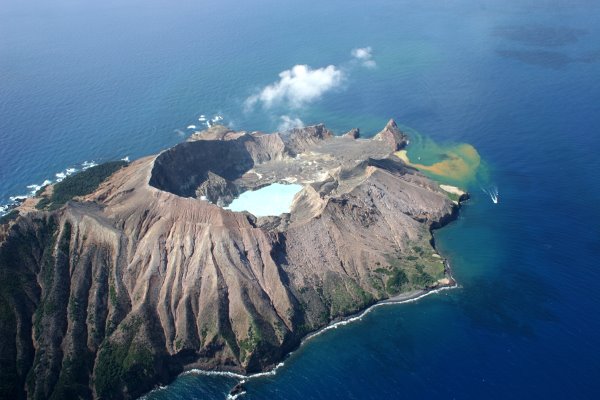
Picture of a steaming volcanic lake in New Zealand
The North Island Volcanic Plateau covers much of central North Island with volcanoes, lava plateaus, and beautiful crater lakes. The three highest volcanoes are Mount Ruapehu (2,797 metres), Mount Taranaki (2,518 metres) and Mount Ngauruhoe (2,287 metres). Ruapehu’s major eruptions have historically been about 50 years apart.

While New Zealand’s volcanic history dates back to before the Zealandia microcontinent rifted away from Gondwana about 60–130 million years ago, activity continues today with minor eruptions occurring every few years. This recent activity is primarily due to the country’s position on the boundary between the Indo-Australian and Pacific Plates, a part of the Pacific Ring of Fire, and particularly the subduction of the Pacific Plate under the Indo-Australian Plate.

Students who are going to study in New Zealand will have the unique opportunity of visiting these beautiful geological entities. Students, tourists and locals who are interested in seeing volcanoes are strongly advised to consult with the authorities in charge and take the necessary safety precautions under the guidance of experienced geologists and guides.

Read More

Wellington city oriental bay area view

There has been a significant increase in the number of Indian students enrolling to various different universities and institutes in New Zealand. According to New Zealand’s high commission there has been a 28 per cent increase in the number of Indian students migrating to New Zealand for studies in the year 2017.

In 2018 there has been a 6 percent increase in enrollments to universities in New Zealand by Indian students along with a 24 per cent overall growth in first-time student visas. There are many reasons why New Zealand is quickly becoming a top destination for Indian students wanting to pursue higher education. Here are a few compelling reasons why you should consider New Zealand as your study destination.

    • Easy entry requirements:When choosing to study in New Zealand you will find that the competition to gain admissions in top quality institutes is considerably lesser than other countries. This is due to the fact that the government of New Zealand has a long history of investing heavily in the education sector, which has in turn given rise to multiple world class universities and institutes.

      New Zealand’s universities and institutes have good infrastructure and implement modern techniques of teaching, allowing them to impart quality education to a greater number of students. Thus even students with moderate grades have a good chance of gaining admission at universities in New Zealand.

Cute red passenger train in New Zealand

    • Affordable cost of living:The cost of living in New Zealand is moderately affordable when compared to other developed countries. Food is abundant and reasonably priced, there is a plethora of student accommodation options and public transport is cheap and well designed allowing for easy cost effective commuting.
    • High quality education:The education system in New Zealand is based on the British education system which also happens to be the foundation for the Indian education system, making it easier for Indian students to adjust. New Zealand’s university education system is a research based system which requires the academic staff to be researchers themselves, this plays a vital role in ensuring and maintaining high standards.
    • Wide variety of opportunities:There are eight universities and multiple government recognized high quality institutes in New Zealand peppered through both the islands (North & South) of New Zealand. Although most of the popular courses in fields like business, information technology and arts are available in all the universities and institutes, there are some highly specialized, unique courses offered by individual institutes.

      The demand for these unique courses is fueled by New Zealand’s thriving local industries such as the viticulture & wine making industry. New Zealand is known globally for its high quality grape produce and great wines.

Snowy coniferous forest in New Zealand with skiing trail.

    • Beautiful country:New Zealand offers the perfect combination of busy cosmopolitan cities and rolling serene countrysides. It boasts of long spotlessly clean beaches, misty hillsides carpeted with pristine coniferous forests, high snow covered peaks and large tracts of orderly farmland.

Maori warrior of New Zealand shows off his skills in a festival.

  • Multicultural society:New Zealand is taking major strides towards becoming a full fledged immigration oriented harmonious multicultural society. While studying in New Zealand’s universities you will come across students from all around the globe including Chinese, Maori, Japanese, Malaysians etc all studying and working together in peace and harmony, offering you the chance to gain invaluable global cultural exposure.
Read More